
Video event production
Event production is filming something live and unrepeatable, a festival, a concert, a conference, on its own schedule rather than one we control. It means shooting something that will only happen once, in front of you, with no second take if the light changes or a headline act runs late.
Coverage plans get built around what cannot be reshot rather than what would look best: an opening address, a specific performance slot, a moment on a schedule that happens once regardless of whether the crew is ready for it. Everything else gets fitted in around those fixed points rather than the other way round.
A run sheet from the event organiser rarely survives contact with the actual day untouched, so we build in a producer whose only job is tracking what has actually happened against what was scheduled, which frees the camera operators to stay focused on what is in front of them.
Redundancy is the whole strategy
A scripted shoot can lose an hour to a camera fault and absorb it into the schedule. An event cannot. If a card fails during the only performance of the night, there is no booking a pickup day. Every piece of kit that matters gets a second one sitting behind it: a backup camera body, a second audio path running independently of the first, a producer with a mental list of what happens if any single piece of the plan fails. None of that redundancy is visible in the finished film. Its entire job is making sure nothing visible in the finished film is missing.
The same logic applies to people. Camera operators on an event get assigned a zone of responsibility rather than a rigid shot list, because a rigid list written in advance cannot account for the moment that actually makes the film, the one nobody could have scheduled. Knowing which operator owns which part of the room means that moment always has somebody's camera already pointed at it.

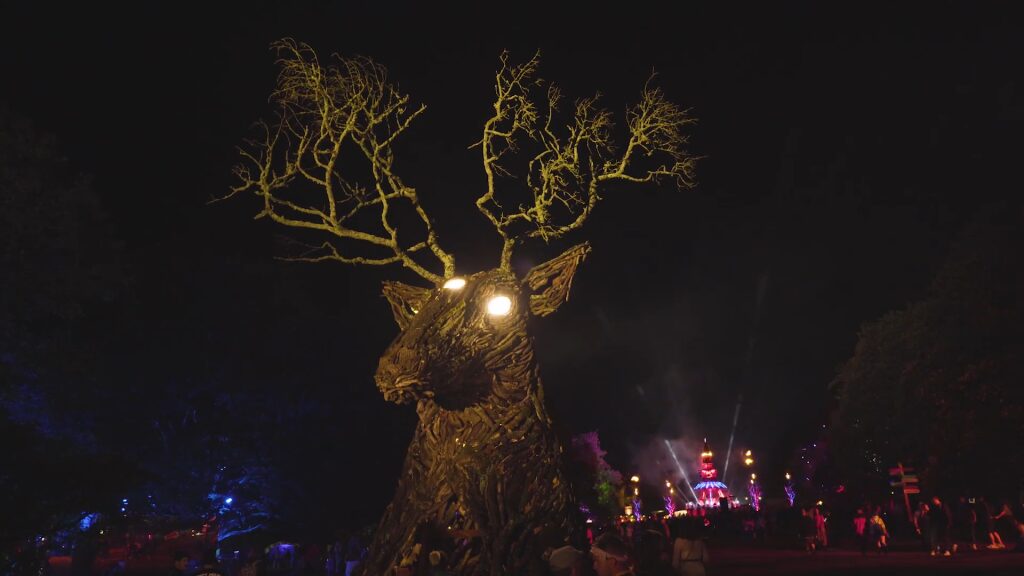
Covering All Together Now for POD meant treating the whole festival as the subject rather than just the stage: production and stage crew, groundskeepers, performers, chefs and the charities on site, because the human element is what actually makes a festival worth capturing, not another angle on a headliner. The Busk Concert Film ran on an even tighter clock: from a phone call to a finished, live-streamed film in twelve days.
Reading a live schedule
A running order on paper is a sequence of names and times. Reading it properly means knowing enough about what each of those slots actually involves to anticipate the shot before it happens rather than reacting once it is already underway: which speaker tends to run long, which act's set traditionally builds to something near the end, where the crowd is likely to be thickest when a particular name is announced. That knowledge mostly comes from having covered enough similar events before, not from the paperwork itself, which is why the same small group of people tend to run point on live coverage rather than whoever happens to be free that week.
We hold a short debrief after most event jobs while the day is still fresh: what the running order didn't warn us about, where a second camera would have paid for itself, which part of the venue nobody flagged as a problem until the crew was standing in it. None of that goes into the finished film, but it goes into how the next one gets planned, which is part of why returning clients tend to need less direction from us each time rather than more.
Working inside someone else's production
An event almost always has its own lighting designer, its own sound engineer, its own stage management, and all of them have a job to do that has nothing to do with the film crew standing in their venue. Event production means working around that existing production rather than asking it to accommodate a camera crew: finding the angle that does not need a light moved, running audio off a desk feed rather than asking for a dedicated mic input nobody budgeted for, staying out of sightlines the venue's own team has already worked out for the audience in the room. The best compliment an event producer can give a film crew afterwards is that they barely noticed them.

Multiple cameras earn their cost on event work in a way they rarely do on a scripted shoot, because there is no do-over if an angle does not work. We would rather cover an event with three cameras and a smaller edit budget than one camera and a bigger one, because the footage a single angle misses cannot be bought back afterward.
Turnaround on someone else's clock
Event coverage often comes with a deadline set by the event itself rather than by the production: a same-day highlights cut shown on screens before the crowd has gone home, a next-morning edit timed to a press cycle, a twelve-day deadline set by when a venue has already been booked for the launch. That compresses every stage behind the camera too. Footage gets backed up and roughly logged on site rather than after the fact, so the edit can start the moment the last camera stops rolling instead of waiting for everything to be ingested first.
Event work rewards a small, fast crew who can make a call and move, because the event itself is never going to wait for a better plan.